
The Power of Reading to Newborns and Toddlers

Cradle of Nutrition
- 4 minutes read
I still remember when I worked as a pedagog in early childhood education how often the quietest moments carried the deepest meaning.
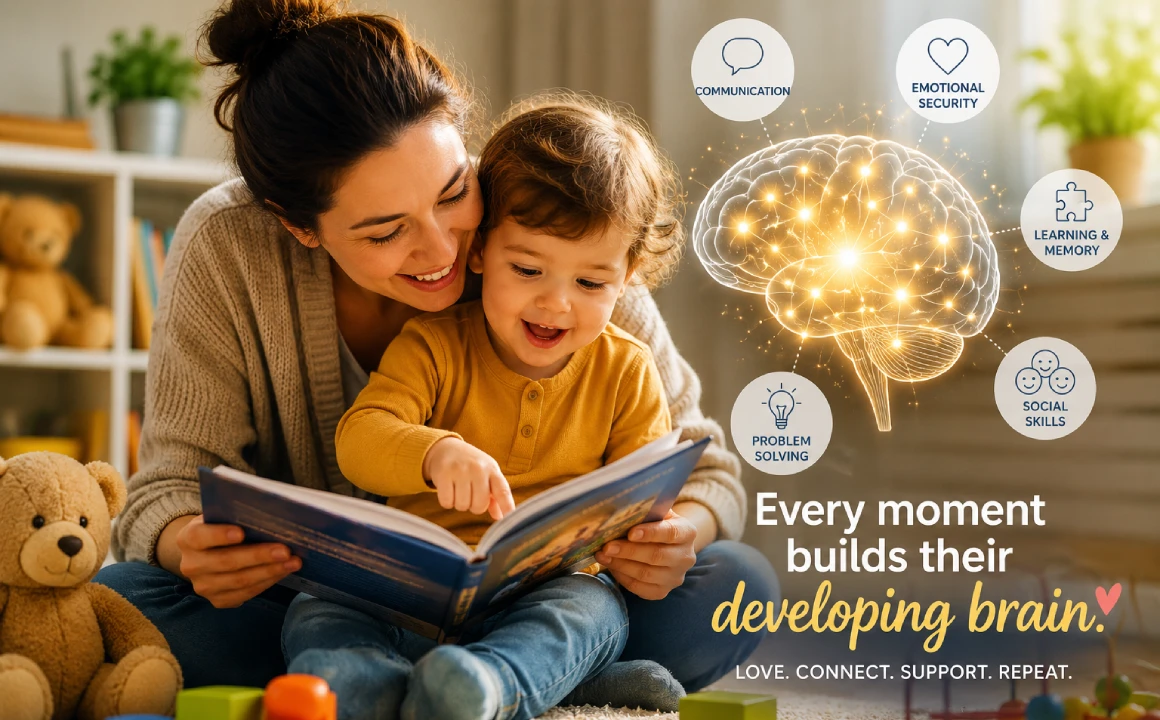
A child sitting on a parent’s lap.
A book slightly too big for small hands.
A calm voice reading slowly, sometimes interrupted by pointing fingers or excited questions.
And what stood out most was this:
It didn’t matter whether the child understood every word.
What mattered was that they wanted to be there.
Over time, I noticed a clear pattern: children who experienced warm, shared reading early were more curious, more confident with language, and more open to learning in general.
This is exactly what modern research in child development now confirms.
👉 Related post: How music builds the brain
Music and reading both strengthen memory, rhythm, and emotional regulation pathways in early development.
How reading shapes the developing brain
Reading to babies and toddlers is not just a language activity—it is a brain-building experience.
The American Academy of Pediatrics highlights that shared reading from infancy supports both early literacy and emotional bonding.
But what does that actually look like in everyday life?
It means that when a baby sits with a parent or trusted adult and hears a story:
- The brain is not just hearing words—it is learning patterns of communication
- The baby begins to associate language with safety, attention, and warmth
- Eye contact, tone of voice, and physical closeness strengthen early brain pathways linked to learning
- The child is not “learning to read” yet—but is learning that communication is meaningful and enjoyable
In simple terms:
📖 Reading becomes a feeling before it becomes a skill.
That emotional foundation is what later turns into motivation to read.
The Harvard Center on the Developing Child explains that early experiences directly shape brain architecture:
In everyday terms, this means:
When a child regularly experiences warm reading moments:
- Language-related brain connections strengthen
- The brain becomes more efficient at processing sounds and words
- Attention and memory systems develop through calm interaction
- Emotional regulation improves through shared, predictable routines
But one of the most important insights from Harvard’s research is this:
It is not only what children experience—it is how they experience it.
A story read with warmth and responsiveness builds a very different foundation than one read with pressure or instruction.
📚 Early reading doesn’t just build language—it builds how a child learns for life.
Why children develop a positive attitude toward books
Children don’t automatically love books—they learn to love them through experience.
A positive reading attitude develops when books are associated with:
- 🫶 emotional closeness
- 😊 joy and shared attention
- 🧠 curiosity and discovery
- 🔁 repetition and comfort
Over time, the child begins to think:
“Books are something I enjoy with people I trust.”
This is the foundation of lifelong reading motivation.
Reading to newborns (0–12 months)
At this stage, reading is about connection, not comprehension.
Babies learn through:
- voice tone
- rhythm and sound patterns
- facial expression
- emotional presence
Simple ways to read:
- read during feeding or bedtime
- use soft, rhythmic voice
- repeat simple books often
- hold the baby close while reading
Reading to toddlers (1–3 years)
Toddlers begin to actively participate in reading.
They often:
- point at pictures
- repeat words
- ask questions
- request the same book repeatedly
What supports learning best:
- short, simple stories
- letting the child lead attention
- talking about pictures together
- connecting stories to real life (“That looks like our dog!”)
Why early reading builds lifelong motivation
Research shows that early shared reading builds intrinsic motivation—the desire to read for enjoyment, not obligation.
Children who experience positive reading interactions are more likely to:
- choose books voluntarily
- stay engaged longer
- feel confident as learners
And this motivation is often a stronger predictor of later academic success than early reading skills alone.
⚠️ Common mistakes to avoid
- Turning reading into a test (“What letter is this?”)
- Focusing on correctness instead of connection
- Only using “educational” pressure-heavy books
- Stopping read-aloud too early
- Treating reading as a task instead of a relationship
Practical tips for parents and educators
✔ Make reading emotional, not instructional
Your voice and presence matter more than perfection.
✔ Follow the child’s interest
Dinosaurs, animals, vehicles, emotions—all are valuable.
✔ Let children participate
Interruptions, questions, and repetition are part of learning.
✔ Keep it consistent
Even 10–15 minutes daily builds strong long-term habits.
✔ Repetition is powerful
Same book again and again = deeper language learning and confidence.
If there is one thing both research and experience in early childhood keep pointing back to, it is this: the impact of early reading is rarely immediate, but it is always lasting.
It doesn’t always look impressive in the moment. A baby might chew the book instead of listening. A toddler might ask for the same story ten nights in a row. Sometimes it feels repetitive, even simple.
But underneath those everyday moments, something important is happening: the child is forming their first relationship with learning itself.
Not with letters.
Not with rules.
But with curiosity, attention, and shared attention with another person.
Over time, these small experiences accumulate into something much bigger. A child who feels safe with books is more likely to approach learning with confidence. A child who associates reading with connection is more likely to return to it willingly. And a child who experiences stories as joy, not pressure, often carries that attitude into school and beyond.
In the end, early reading is not about preparing a child for school—it is about shaping how they relate to learning for the rest of their life.
by Erika Barabás