How Your Child’s Brain Grows: A Simple Guide for Parents (That Actually Makes Sense)

Cradle of Nutrition
- 4 minutes read
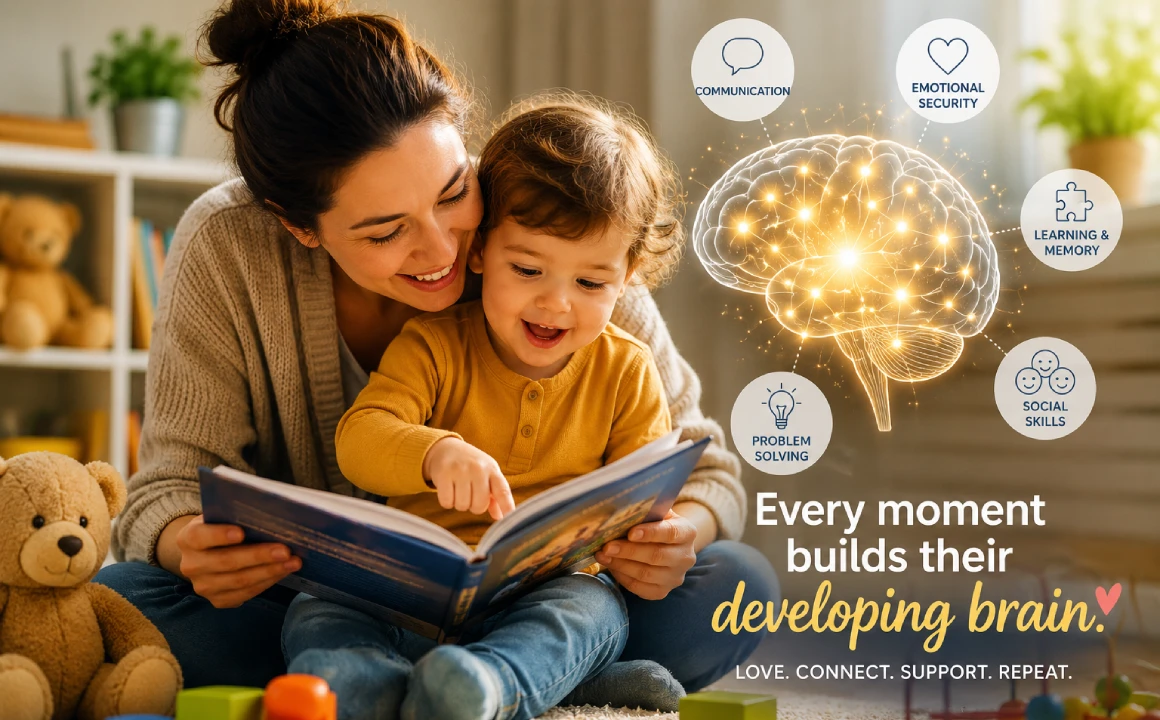
Every hug, every conversation, every moment of comfort is helping to build your child’s brain.
Understanding Child Brain Development Starts Here
Child brain development is one of the most important and fascinating parts of early parenting. From the moment a baby is born, their brain is rapidly growing, forming millions of connections every second that shape how they will think, feel, learn, and interact with the world.
What many parents don’t realize is that child brain development is not just biological — it is deeply shaped by everyday experiences and relationships. Simple moments like talking, comforting, playing, and reading are not small actions, they are powerful experiences that physically build the structure of the brain.
During early childhood, the brain is highly flexible and sensitive. This means that positive experiences can strengthen healthy brain pathways, while ongoing stress without support can interfere with optimal development.
That is why understanding child brain development is so important for parents — because every interaction you have with your child is contributing to the foundation of their lifelong learning, emotional health, and behavior.
Your Child’s Brain Is Under Construction
If you take one thing from this article, let it be this:
Your child’s brain is not “finished” — it is being built every single day.
And you, as a parent or caregiver, are one of the most important “builders.”
From birth through early childhood, the brain is growing at an incredible speed. It forms millions of new connections every second. These connections shape how your child will:
- Think
- Learn
- Speak
- Handle emotions
- Build relationships
So yes — bedtime stories, hugs, tantrums, and even everyday conversations all matter more than they may seem.
Think of the Brain Like a House Being Built
The brain is often compared to a house under construction.
- The foundation is built first (early childhood)
- The walls and structure are formed through experiences
- The design and wiring depend on daily life and relationships
A strong foundation makes everything that comes later easier — learning at school, making friends, and managing emotions.
The Magic of Everyday Moments (Serve and Return)
One of the most important discoveries in brain science has a simple name:
“Serve and Return”
It sounds technical, but it’s actually something you already do every day.
It works like a game:
- Your child “serves” → they cry, smile, point, or ask
- You “return” → you respond with words, comfort, or attention
Examples:
- Baby babbles → you talk back
- Child points at a dog → you say “Yes, that’s a dog!”
- Child cries → you comfort them
These tiny moments build something huge in the brain:
- Trust
- Language
- Emotional safety
- Confidence
💡 The brain literally grows stronger when children feel seen and heard.
Why the Early Years Matter So Much
The early years (especially 0–5) are when the brain is most flexible.
Scientists call this brain plasticity — meaning the brain can change and adapt easily.
This is a good thing.
It means:
- Children learn languages faster
- Emotional habits are formed early
- Social skills develop quickly
But it also means early stress or neglect can have a stronger impact.
The good news?
The brain is also very responsive to love, safety, and repair.
It’s never about being perfect — it’s about being present most of the time.
Stress: Not Always Bad, But It Matters
Not all stress is harmful.
There are 3 types:
1. Positive stress
Short-term challenges (like meeting new people)
2. Tolerable stress
Difficult experiences, but with support (like losing a pet with comfort from adults)
3. Toxic stress ⚠️
Long-term stress without support (like ongoing neglect or violence)
Toxic stress can affect areas of the brain responsible for:
- Learning
- Memory
- Emotional control
But here is the most important point:
A caring adult can protect a child’s brain from the effects of stress.
What Builds a Strong Brain?
You don’t need special tools or perfect parenting.
What matters most is consistency in small things:
💬 Talk often
Even simple conversations build language and thinking skills.
📖 Read together
Reading strengthens imagination and attention.
🤗 Comfort emotions
When children feel safe, their brain learns to regulate stress.
🎲 Play every day
Play builds creativity, problem-solving, and social skills.
🕒 Keep routines
Predictability helps the brain feel secure.
😴 Sleep and nutrition
A growing brain needs rest and fuel.
The Big Idea (If You Remember Nothing Else)
Here is the simplest way to understand everything:
👉 Every warm, responsive interaction helps build your child’s brain.
👉 Every repeated experience strengthens brain pathways.
👉 A safe relationship is the foundation for all learning.
You are not just raising a child.
You are shaping a developing brain — one moment at a time.
What Science Tells Us
Research from leading institutions shows that early experiences influence:
- School success
- Emotional health
- Stress response
- Future relationships
- Physical health
This is why early childhood is often called the most important period of brain development.
Parenting is not about doing everything perfectly.
It’s about showing up, again and again.
Because in your child’s brain, these everyday moments are not small.
They are the blueprint of a lifetime.
by Erika Barabás
Sources: